If you’re selling internationally, you’ve probably thought:
“Alright, I just need to show the right currency.”
So you add a currency converter, switch everything to €, £, whatever…
…and expect conversions to go up.
They don’t.
Because the issue was never the currency in the first place.
Currency Is Just the Surface-Level Problem
Currency is just what people notice.
But what actually drives conversions is everything underneath it.
You can show € instead of $, but if:
-
the pricing feels off
-
the page still reads like it was written for a US audience
-
the payment methods don’t feel familiar to that country
…it still feels like a “foreign” store.
And people hesitate.
Where Most Dropshippers Get It Wrong
The typical approach is:
 “Let’s convert USD → EUR and we’re good”
But that assumes all markets behave the same.
They don’t.
Different countries have:
-
different price sensitivity
-
different expectations
-
different buying habits
£29.99 might feel like a no-brainer in one market…
and overpriced in another.
So even if your currency is “correct”, your offer still isn’t aligned.
What Actually Moves the Needle
Once you’ve tested a few markets, you start noticing something:
It’s not just about showing the right price - it’s about making the whole experience feel local.
That includes:
-
how the price is positioned
-
how the offer is structured
-
what payment methods are available
-
even how the copy is written
That’s where most setups fall apart.
Because a simple currency converter can’t handle any of that.
What This Looks Like in Dropshipping
This is where things start to matter a lot more for dropshipping specifically.
Because unlike local brands, you’re often:
-
testing multiple countries
-
running the same product across different markets
-
scaling what works, fast
And that’s exactly where a simple “currency conversion” setup starts to break.
You end up sending traffic from different countries to the same exact funnel…
just with a different currency symbol.
But the experience isn’t actually adapted.
What Advanced Dropshippers Do Differently
Once you’ve been running ads across multiple countries for a while, you start noticing patterns.
Some offers work better in certain regions.
Some price points convert better depending on the market.
Some payment methods make or break the checkout.
At that point, the question stops being:
“How do I convert currency?”
And becomes:
“How do I adapt this funnel per country without rebuilding everything from scratch?”
This Is Where Geo Funnels Come In
Instead of just swapping currencies, you start adapting the entire funnel based on location.
Same URL, but a different experience depending on where the visitor is coming from.
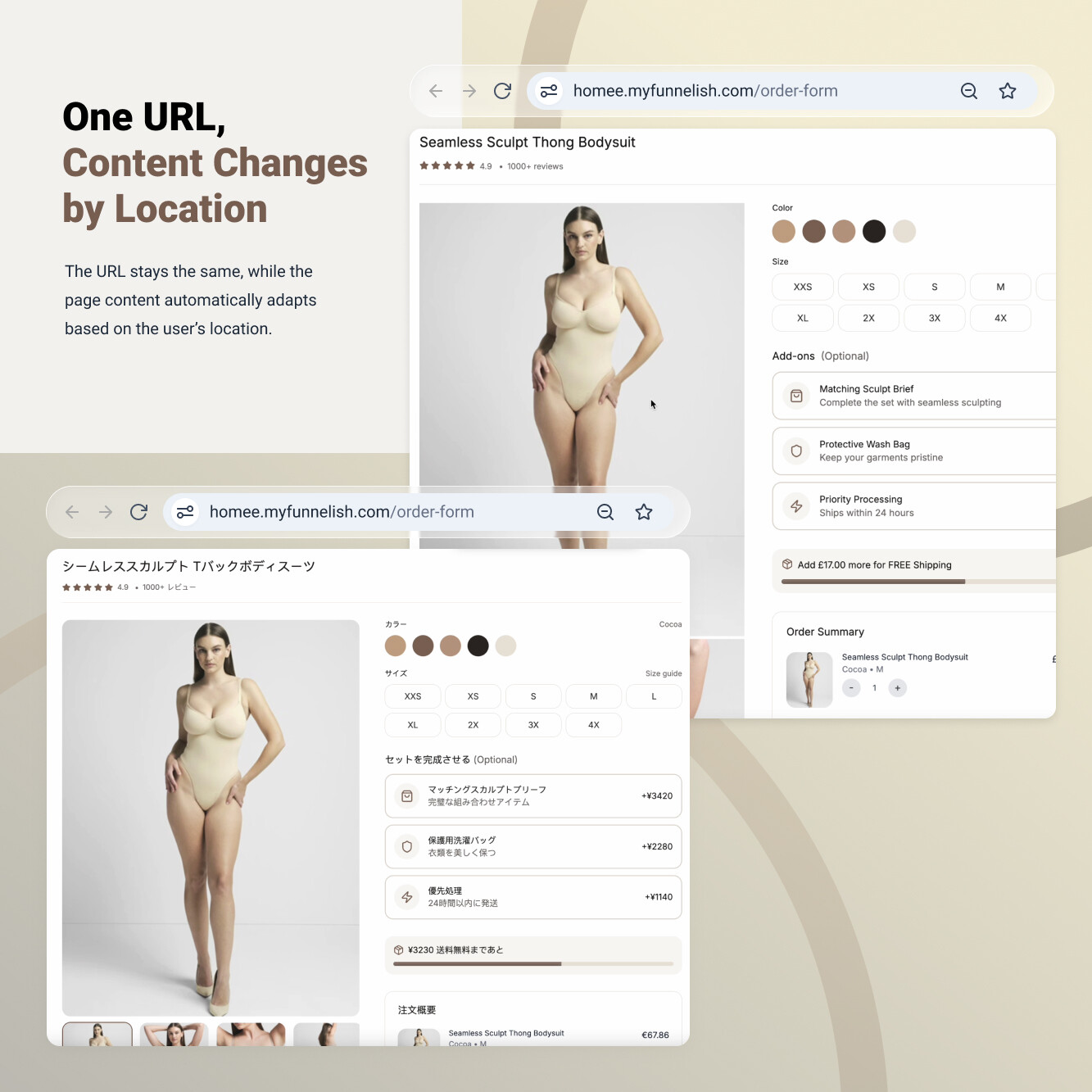
So for example:
Someone from France might see:
-
€ pricing
-
slightly different pricing logic
-
local payment methods
-
messaging that feels more natural
Someone from the US sees:
-
$ pricing
-
a different offer structure
-
US-focused copy
And all of this happens automatically.
No redirects. No “choose your country” popups. No managing multiple URLs.
Read more on Geo Funnels
Why This Works So Well for Dropshipping
This is where things start to click.
Instead of forcing one funnel to work everywhere, you’re:
-
matching the experience to the market
-
increasing relevance
-
removing small points of friction that kill conversions
And those small improvements compound:
-
better conversion rate
-
higher AOV
-
stronger ad performance
Currency conversion feels like the problem when you first start selling internationally.
But it’s really just the entry point.
If you’re serious about scaling dropshipping across multiple countries, the goal isn’t just to show the right currency, it’s to make the entire experience feel local.
Once you start thinking that way, everything changes.